| Home | Kuliah Elektro | Elektronik Project | Tutorial | Download | Donasi | |
|
|
||||||
|
more search type here |
||||||
|
|
|
|
|
|
|
|
|
|
|
|
|
|
|
|
|
|
Gamma Match Antenna By Arif Johar Taufiq
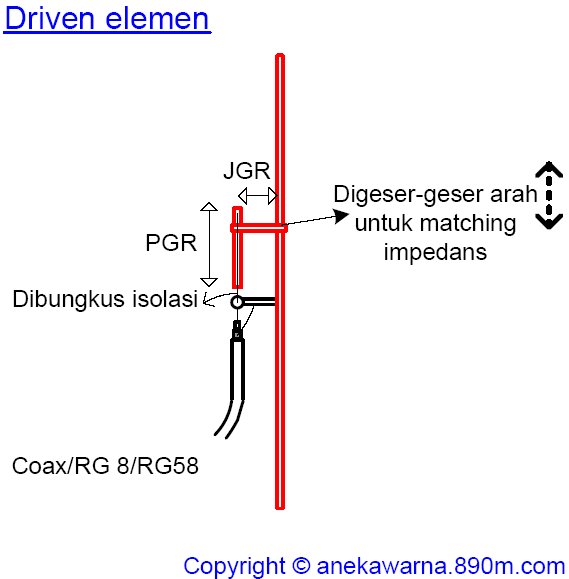
Gamma match antenna is an antenna 1/2 additional lambda with the impedance matching more flexible arrangements (var capacitor) by sliding through the gamma match/road. This type of antenna I've ever rafts (th 1994) and used for the FM transmitter with excellent results in setting an appropriate impedance. Measurement of stable 1:1 SWR be quite small. Unfortunately at that time there was no documentation photo An antenna (or aerial) is a transducer designed to transmit or receive electromagnetic waves. In other words, antennas convert electromagnetic waves into electrical currents and vice versa. They are used with waves in the radio part of the electromagnetic spectrum, that is, radio waves, and are a necessary part of all radio equipment. Antennas are used in systems such as radio and television broadcasting, point-to-point radio communication, wireless LAN, cell phones, radar, and spacecraft communication. Antennas are most commonly employed in air or outer space, but can also be operated under water or even through soil and rock at certain frequencies for short distances.
Physically, an antenna is an arrangement of one or more conductors, usually called elements in this context. In transmission, an alternating current is created in the elements by applying a voltage at the antenna terminals, causing the elements to radiate an electromagnetic field. In reception, the inverse occurs: an electromagnetic field from another source induces an alternating current in the elements and a corresponding voltage at the antenna's terminals. Some receiving antennas (such as parabolic and horn types) incorporate shaped reflective surfaces to collect EM waves from free space and direct or focus them onto the actual conductive elements. Antennas were used in 1888 by Heinrich Hertz (1857–1894) to prove the existence of electromagnetic waves predicted by the theory of James Clerk Maxwell. Hertz placed the emitter dipole in the focal point of a parabolic reflector. He published his work and installation drawings in Annalen der Physik und Chemie (vol. 36, 1889).
Antena gamma match merupakan antena 1/2 lamda dengan tambahan matching impedans yang lebih fleksibel pengaturannya (var kapasitor) dengan menggeser-geser lewat gamma match/roadnya. Jenis antena ini pernah saya rakit (th 1994) dan dipakai untuk pemancar FM dengan hasil bagus pada settingan impedans yang pas. Pengukuran SWR dapat stabil 1:1 cukup kecil. Sayang waktu itu belum ada dokumentasi fotonya Antena saya pasang vertikal hanya drivennya saja di dalam kamar setinggi 170 cm dengan kabel belden RG 58 dapat mencapai paling tidak -+5 Km (dari wirobrajan Gg. Gatotkoco sampai sekitar alun-alun kraton YK) apa lagi jika dipasang diluar rumah dan pada ketinggian cukup tinggi.
Figure 1. Gamma Match Antenna
Details:
Examples If our radio transmitter working at 100 MHz frequency, so The Lambda ( l )=> Lambda l = C/f ; C = 3 x10⁸ m/s ray velocity, f = frequency Hz
l = (3 x 10⁸)/100x106 = 3 m
Driven = (1/2)x 3 m = 1,5 m Reflector = 1,03 x 1,5 = 1,545 m D1= 0,94xDriven = 0,9 x 1,5m = 1,35m D2= 0,99 xD1 = 0,99 x 1,35m =1,3365 m D3 = 0,99x D2 = 0,99 x 1,3365m = 1,323135 m D4 = 0,99 x D3 = 1,30990365 m
Gamma road = 0,15 x Driven = 0,15 x 1,5m = 0,225 m
Gamma road to driven element = 0,025 x Driven = 0,025 x 1,5m = 0,0375 m
|
|||||
|
|
|
|
|
|||
Copyright (C) guru.technosains.com
For problems or questions regarding this web contact [admin]